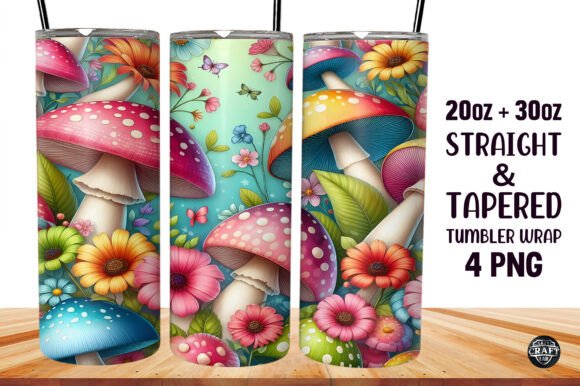
Woodland Mushroom Tumbler Sublimation
A Designer’s First Glance: Whimsy, Warmth, and Quiet Confidence
When I opened the Woodland Mushroom Tumbler Sublimation file, what struck me wasn’t just the charm—it was the intention. This isn’t a cluttered forest scene or a cartoonish mushroom parade. It’s a gentle, layered composition: soft caps with subtle gills, delicate stems, tiny ferns curling at the base, and a quiet negative space that breathes. The layout wraps naturally around a skinny tumbler shape—so it’s clearly built for curvature, not flat panels—but as an embroidery designer, my mind immediately jumped to how those organic curves and tapered stems would translate into satin stitch, fill stitch, and fine running-stitch accents on fabric.
Where This Design Truly Comes Alive
I recently prepped a custom embroidered tote bag for a local nursery boutique—think linen-cotton blend, medium weight, natural undyed tone. I mocked up the Woodland Mushroom Tumbler Sublimation scaled down to 4.5” wide and rotated 90° to run vertically along the side seam. Instantly, it felt right: the mushrooms’ vertical rhythm echoed the tote’s clean lines, and their earthy silhouette added handmade warmth without overwhelming the minimalist aesthetic. That’s where this design shines—not as a standalone logo, but as a quiet signature on sweatshirt cuffs, baby onesie hems, tea towel corners, or pillow covers meant for calm, nature-inspired spaces.
It also works beautifully as an embroidered patch. Because the shapes are rounded—not sharp or angular—the satin stitch flows smoothly over the edges, minimizing puckering even on lightweight twill backing. I’ve used similar motifs for boutique aprons and holiday gift sets (think mushroom-embroidered kitchen towels bundled with foraged tea), and the Woodland Mushroom Tumbler Sublimation fits that same thoughtful, small-batch energy.
Real Embroidery Considerations: What Works—and What Needs Care
This isn’t a “drop-in-and-stitch” machine embroidery design. It’s a sublimation graphic—so before you digitize or adapt it, pause. Ask: Does my embroidery software handle organic outlines cleanly? Will those tiny gills hold detail at 3” height? On baby embroidery or delicate cap fronts, simplify or omit the finest stem textures. On stretchy fabric like cotton jersey, use cutaway + tear-away stabilizer combo and reduce stitch density slightly in curved fill areas—mushroom caps can distort if overly dense.
Dark fabric demands attention too. That soft gray-brown stem tone? Lovely on cream or oat linen—but on charcoal, it’ll vanish unless you adjust thread colors intentionally (try moss green + warm taupe instead of slate). And avoid placing it near high-friction zones like tote bag handles or sweatshirt sleeve seams unless you reinforce stitching or add a small satin-stitched border for durability.
How It Shapes Perception—Before and After Stitching
Customers don’t just buy mushrooms—they buy mood. A finished product featuring the Woodland Mushroom Tumbler Sublimation signals care: hand-selected motif, intentional scale, tactile execution. That builds trust faster than generic florals or overused icons. For Etsy sellers, it elevates a plain tea towel from “nice” to “curated.” For craft fair vendors, it adds narrative depth to a line of nursery decor—no explanation needed, just quiet recognition.
But here’s the nuance: its subtlety means it won’t pop on busy prints or heavily textured fabrics like bouclé or thick terry cloth. On those, it risks looking washed out or indistinct. Save it for smooth-to-medium weaves—linen, quilting cotton, midweight french terry, or stable knits—where stitch definition stays crisp and the design’s gentle personality reads clearly.
Practical Notes Every Embroidery Designer Should Run Through
- Always test first—on scrap fabric matching your final product’s weight and stretch.
- Check thread color contrast across light and dark backgrounds; don’t assume the original palette translates.
- Review stitch density—especially under mushroom caps—avoiding unnecessary layers that cause stiffness or bulk.
- Confirm hoop size compatibility; if adapting for a 4” hoop, trim excess negative space—not key details.
- Inspect small details at actual stitch-out size: do those tiny gills read, or blur into a blob?
- Test black-and-white mockups to assess value contrast—critical for branding consistency.
- Use proper stabilizer: medium cutaway for knits, tear-away for stable wovens, no-show mesh for sheer layers.
- Verify licensing before selling finished items or digital embroidery files—you’ll need clear commercial rights for craft business use.
Final Thought: A Design That Serves the Maker, Not Just the Machine
The Woodland Mushroom Tumbler Sublimation doesn’t shout. It settles in—like moss on stone, like steam rising from a morning mug. That makes it unusually versatile for handmade product lines where authenticity matters more than flash. It supports your voice rather than competing with it. Whether you’re digitizing it for a custom embroidered patch, scaling it for a baby blanket corner, or adapting it into a printable mockup for your Etsy listing, treat it with the same quiet respect it extends to the woodland world it evokes. Let it breathe. Let it complement. And above all—test, refine, and stitch with intention.